
More than half a billion flashes
Lightning imager details storms like never before
EUMETSAT’s Remote Sensing Scientist Sven-Erik Enno reflects on the Meteosat Third Generation Lightning Imager impacts, following its first full operational year
More than half a billion flashes
Lightning imager details storms like never before
EUMETSAT’s Remote Sensing Scientist Sven-Erik Enno reflects on the Meteosat Third Generation Lightning Imager impacts, following its first full operational year
On the night of 4 November 2025, a dangerous autumn storm swept toward the Iberian Peninsula. Meteorologists at the Portuguese Institute for Sea and Atmosphere issued orange weather alerts – the country's second-highest warning level – across most districts as an unusually intense cold front moved in from the Atlantic.
The storm brought torrential rain and powerful winds that caused floods and widespread property damage and displayed exceptional lightning activity: more than 30,000 flashes across Portugal alone, numbers far exceeding typical November storm activity.
“To track lightning, forecasters have so far relied on ground-based sensors that detect radio waves from lightning discharges,” says Dr Sven-Erik Enno, who works in the Lightning Imager team at EUMETSAT in Darmstadt, Germany.
23:55, 4 November 2025
23:55, 4 November 2025
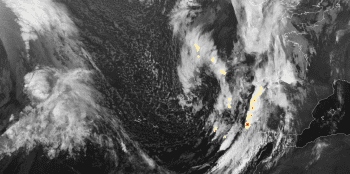
“While these systems excel at observing cloud-to-ground strikes, they are less effective at detecting cloud lightning, which makes up more than three quarters of all lightning activity as well as lightning over oceans and remote areas where ground-based systems are sparse or absent.
“Since July 2024, the Lightning Imager on board Meteosat-12 has been providing an invaluable new type of data from its geostationary vantage point that helps fill in these gaps. The instrument’s performance has been generally very good and stable throughout the entire period with better coverage and better sensitivity than ground-based networks over remote areas and uniform data sets that are being used by many different specialists.
“The Lightning Imager observes continuously from space across a vast area that includes Europe, Africa, the Atlantic, Middle East, the western part of the Indian Ocean, and parts of South America and surrounding regions, detecting both cloud-to-ground and intracloud lightning flashes across its entire field of view.”
608 million
lightning flashes
Image: Sven-Erik Enno
In 2025 – the instrument's first full operational year – the Lightning Imager’s four cameras recorded more than 608 million flashes across Europe, Africa, and South America and surrounding regions. The data is displayed here as a grid, with each cell showing accumulated lightning strikes in that area – red indicates the most intense activity, fading to purple for the least.
Monthly totals throughout the year show how lightning activity shifted seasonally between different regions.
More than 30 million flashes were observed over Europe, with some days seeing nearly half a million strikes across the continent. The busiest day came on 23 September, when 464,787 flashes were recorded.
“Major European hotspots include the southern Alpine foothills of northern Italy, the Pyrenees, and eastern Spain,” says Enno. “Lightning activity generally decreases towards higher latitudes and over oceans, where cloud microphysics are known to be less favourable for electrical charging and lightning formation.
The highest incidences of lightning within the instrument’s field of view are seen over the Congo River Basin, which alone produced more than 30% of the total annual flashes detected by the Lightning Imager.
Zooming in on storm and lightning structure
The intensity and longevity of African thunderstorms is showcased on this LI Accumulated Flash Area animation overlaid on Meteosat-12’s Flexible Combined Imager GeoColor RGB images.
“Because it detects cloud lightning that ground networks miss, the Lightning Imager reveals the true horizontal extent of total lightning activity in thunderstorms for the first time,” Enno explains. “The Congo Basin – likely Earth's most intense lightning hotspot – produces hundreds of thousands of flashes daily and the sheer numbers we are seeing are astounding.”
“The combination of the instrument’s unique extended field-of-view and the almost uniform detection performances enable meteorologists to see the space and time patterns of thunderstorms in unprecedented detail. We are seeing that the instrument can outperform ground-based systems even beyond 60 degrees north on the edge of the Arctic Circle, with weather services widely praising the instrument’s high performance.”
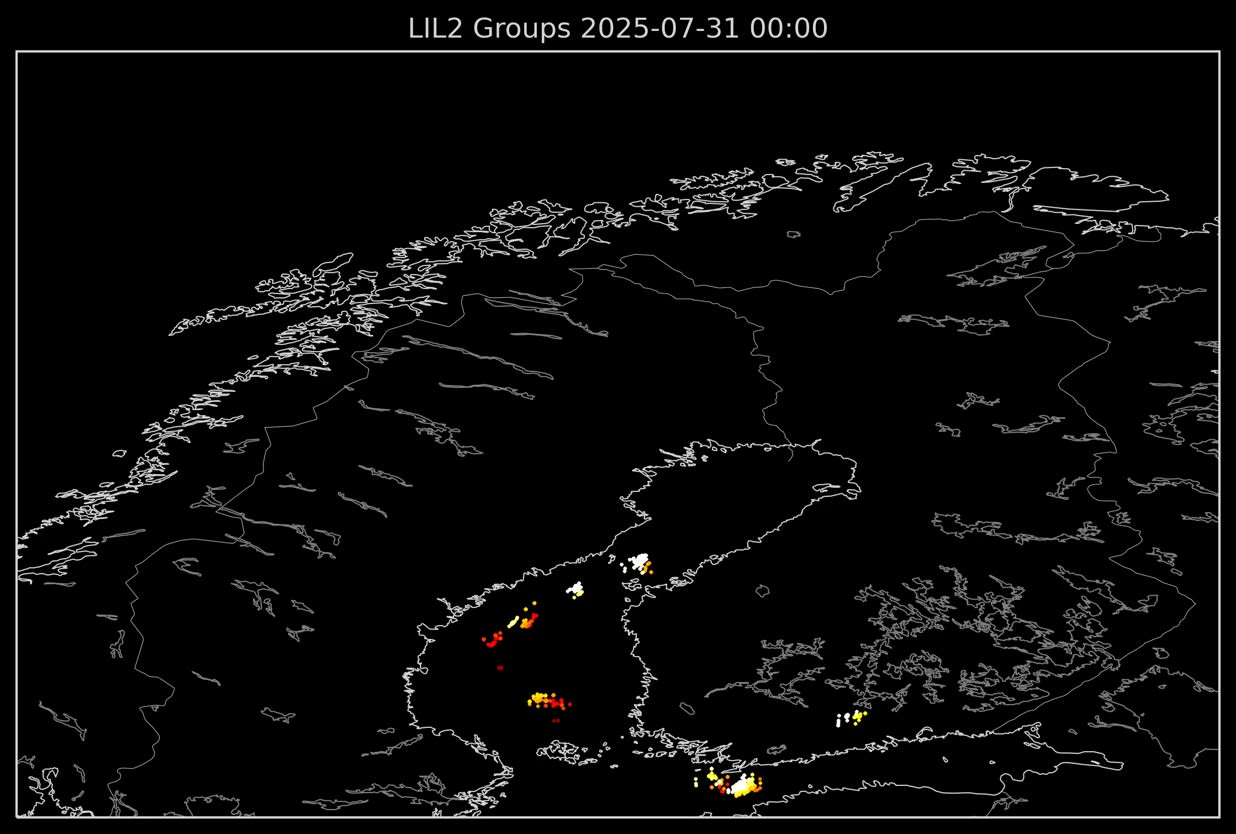
The lightning Imager records its full field-of-view at a rate of 1000 frames per second. On each frame, lightning illuminated cloud tops appear as spatial clusters of illuminated pixels, defined as ‘lightning groups’ in the data provided to end users such as weather forecasters. The lightning groups dataset reveals the horizontal extent of electrical activity in clouds as well as fine details of individual lightning flashes. In animations of thunderstorms in Finland and northern Scandinavia during 31 July to 1 August 2025 group locations can be seen colour-coded in 10-minute intervals, with white colouring representing those recorded during the past 10 minutes (the most recent) spanning to dark red representing groups recorded 50-60 minutes ago (the oldest).
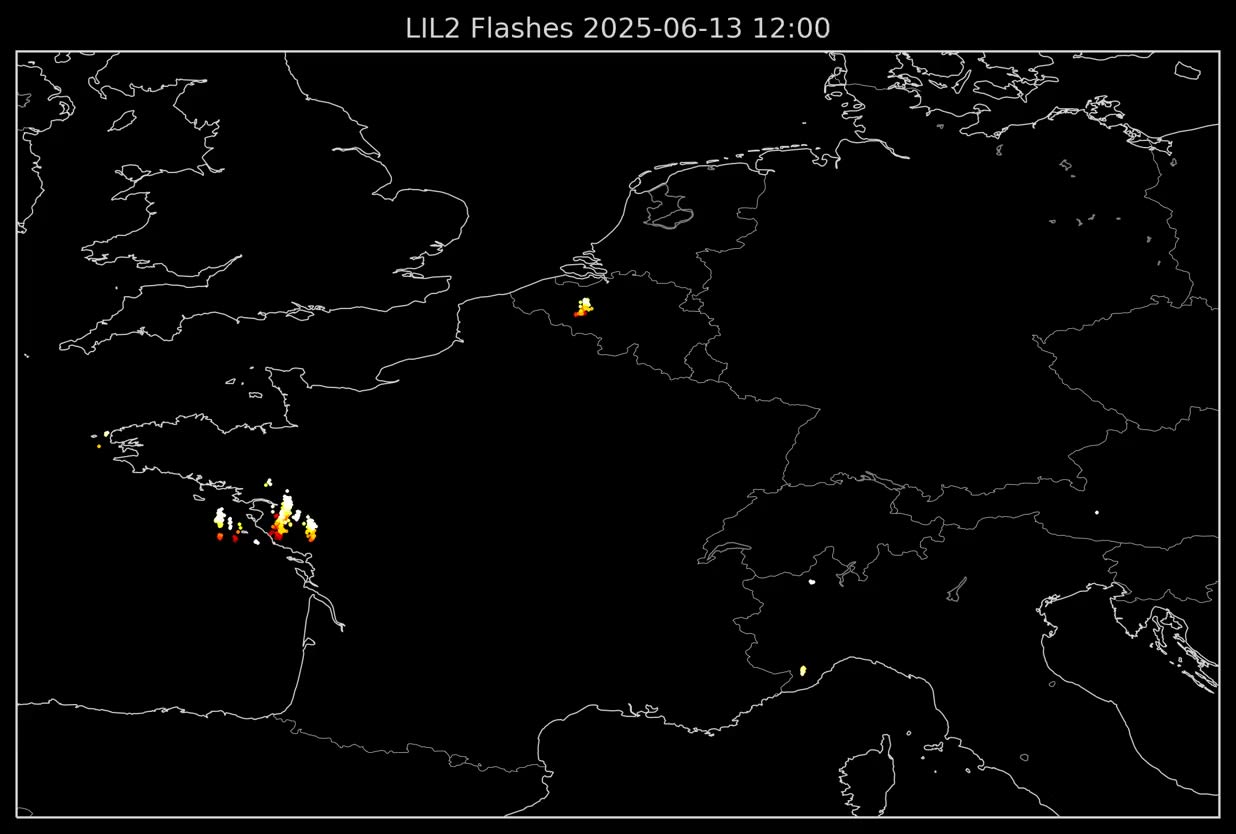
Beyond giving an incredibly rich overall picture of the large-scale lightning patterns in space and time across its field-of-view, Lightning Imager data also provide unprecedented insights into individual weather systems. On 13 June 2025, a storm over Normandy, France and the United Kingdom produced hundreds of thousands of lightning strikes, with the Lightning Imager capturing the storm's evolution as it moved eastwards.
“Lightning is essentially a giant electric spark from electrostatic discharge between charged regions in the atmosphere, and by capturing as many of these flashes as possible, meteorologists can add vital details when tracking storm evolution,” Enno explains.
“Lightning Imager data enable forecasters to spot lightning jumps – rapid increases in flash rates signalling that severe weather such as hail and high winds may arrive within 10 to 20 minutes. Depending on the product, data are provided to forecasters in 10 to 30 second chunks and EUMETCAST users can access it within seconds from generation. So, if a lightning flash occurs somewhere, then they can have the data available within one minute or so.”
Storms over Southern Europe in August 2025 visualised using Lightning Imager’s accumulated flash area on top of Flexible Combined Imager’s GeoColor RGB images.
“The ability to detect the onset of lightning in developing convective clouds and monitor its frequency through the storm life cycle has massive potential to benefit both short-term nowcasting and longer-term forecasts,” Enno says.
“Cloud-to-ground lightning typically extends a few kilometres, while intracloud flashes can extend much further, occasionally spanning hundreds of kilometres, even across several countries,” he explains. “Ground-based networks may show only scattered strike points where lightning hits the ground; however, viewed from space it is possible to see that the entire cloud system is electrically active.
“Having this complete picture is crucial for aviation safety: a pilot seeing reports of isolated strikes tens of kilometres apart might choose to fly, unaware those strikes are part of a larger lightning flashes covering the extended area horizontally. Changes in lightning frequency may also signal storm intensification, helping forecasters track how storms are developing and organising.”
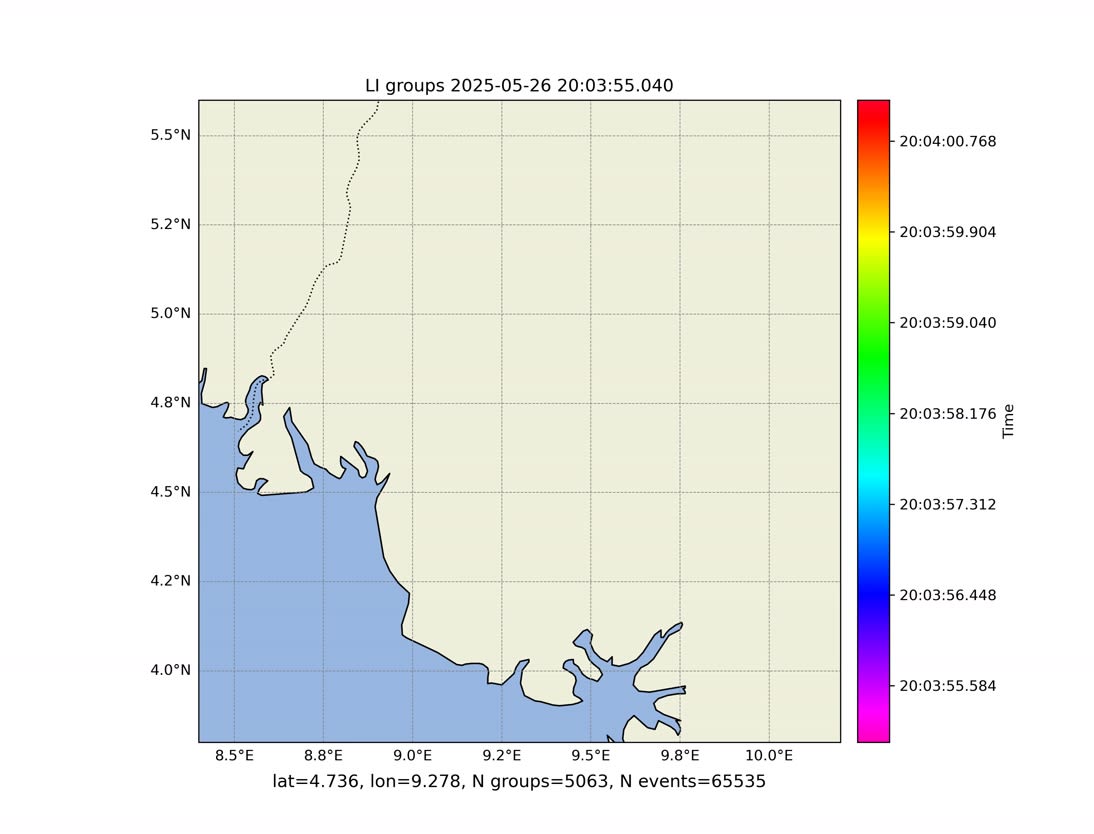
This animation is based on near-real-time Lightning Imager data detailing a lightning megaflash in Africa. Small dots show groups of illuminated pixels detected by the Lightning Imager, X symbols represent cloud-to-ground lightning strikes, while O symbols show cloud lightning detected by ground-based systems. Colours indicate timing, revealing how this megaflash evolved over several seconds.
Hidden connections
Lightning observed in cloud tops, combined with imagery from Meteosat-12's Flexible Combined Imager, can also shine light on a storm’s life stage and severity.
“The Flexible Combined Imager’s infrared channels enable meteorologists to detail cloud top temperatures, with the coldest temperatures indicating the development of deep convection, while the frequency and size of lightning flashes can give an indication of the storm’s maturity,” Enno says. “These observations also provide invaluable information for weather prediction models, with studies showing improvements to forecasts of Mediterranean storms, and exciting potential to contribute to next generation forecasting systems."
Long-term, the continuous data streams will enable scientists to improve observations of many aspects of weather and climate ranging from seasonal and annual weather patterns to climate change effects.
“The Gulf of Guinea, for instance, shows morning lightning maxima offshore around dawn, Lake Victoria activity peaks at night, however areas surrounding the lake see typical afternoon thunderstorm activity peaks,” says Enno. “With lightning causing up to 24,000 deaths globally per year, knowing when lightning is more likely to strike could be potentially valuable for developing warning systems.”
Hourly Lightning Imager lightning flash accumulation over and around Lake Victoria during 2025. Lightning activity peaks above the lake at night, while over the surrounding areas it peaks in the afternoon.
Storm seeker
Growing up in Estonia, Enno, like many people, saw thunderstorms as something rather frustrating that could ruin plans on a summer’s day, before his curiosity about tracking them transformed his caution into fascination.
Image: Katri Enno
Image: Katri Enno
"Since the 1950s, weather forecasters have relied on progressively better approaches, from hand-plotted weather maps to today's high-resolution models that can detail very small-scale atmospheric features,” Enno says. "But no single tool provides the complete picture. The Lightning Imager adds critical pieces of the puzzle that forecasters can combine with radar, other satellite imagery, surface observations, and their own experience and judgment to make decisions.
“When the first data came in from the Lightning Imager, it was amazing to see patterns over Europe and Africa that no one had observed from space before. I am proud to be part of an incredible team, ensuring the delivery of data that supports weather institutions in providing services that potentially benefit hundreds of millions of people in the Lightning Imager's field of view.”
Author: Adam Gristwood
Main image: Sven-Erik Enno
 Built with Shorthand