
TRACKING LIGHTNING'S UNPREDICTABLE PATH
How forecasters at the Polish Institute of Meteorology and Water Management use EUMETSAT satellite data to support predictions of extreme weather events.
TRACKING LIGHTNING'S UNPREDICTABLE PATH
How forecasters at the Polish Institute of Meteorology and Water Management use EUMETSAT satellite data to support predictions of extreme weather events.
On 22 August 2019, after a calm, sunny morning, a storm swept across Poland‘s Tatra Mountains.
On the summit of Giewont, a 1,894-metre peak popular with hikers, lightning struck a metal cross. The current surged through the handrails, killing four people and injuring many more.
“Stormy conditions were forecast, but no major event was anticipated,” says Zuzanna Babicka, a weather forecaster at the Polish Institute of Meteorology and Water Management (IMGW).
“However, lightning doesn’t need a severe storm to be deadly. Just a single strike in the wrong place at the wrong time turned a routine hike into a tragedy.”
Even the most advanced weather models cannot pinpoint exactly when and where lightning will strike. However, by drawing from a wide range of data sources, forecasters can enhance predictions of intense convective activity.
“In southern Poland, the storm season can last from April to September,” says Babicka, who is based in Kraków. “One of the biggest challenges for forecasters during this time is interpreting data to predict how weather systems will evolve over the very short term – known as nowcasting.
“Some of the most dangerous events are also the hardest to predict. Meteorological satellite data are an essential resource, offering crucial insights into rapidly developing weather systems.
“When nowcasting, it’s crucial to quickly recognise patterns in these observations. If current conditions look like those three days ago, why is the weather behaving differently this time? How might subtle changes in wind, humidity, or temperature affect storm formations?
“When answering such questions, there’s always more to analyse.”
To support forecasters in their work, walls at the IMGW forecast centre are lined with monitors displaying the latest satellite images from missions such as EUMETSAT’s Meteosat and Metop programmes.
“At 14:00 each day, forecasters gather for a satellite briefing, where specialists pore over data and explain what is being shown on different instrument channels,” Babicka says.
“EUMETSAT programmes provide a wealth of observations, helping forecasters characterise atmospheric conditions and improve predictions for the hours ahead.
“For example, satellite data products making use of EUMETSAT data allow us to estimate rainfall, assess storm intensity, map wind patterns, and analyse cloud structures.
“New instruments, such as the Meteosat Third Generation Lightning Imager, provide valuable opportunities to track lightning flash rates.
“All these data are invaluable in monitoring storms.”
Babicka explains that between delivering scheduled updates, she also uses satellite and radar data to keep a constant check that the current weather remains within the boundaries of predictions.
“If conditions change unexpectedly, we immediately issue amendments to forecasts,” she says.
“If hazardous weather is expected, we provide alerts and hold coordination meetings with colleagues to discuss forecasts for different regions.”
IMGW Director Robert Czerniawski (fifth from the right) convened with Donald Tusk, Poland's Prime Minister, and other officials for a civil emergency meeting during the September 2024 floods.
Photo: Mateusz Krzystanski/ Panstwowa Straz Pozarna
In September 2024, Storm Boris claimed around 30 lives across Central Europe, including nine in Poland, where more than 6,500 people were evacuated and 11,500 homes were damaged. Flood barriers were breached, towns inundated, and a state of disaster was declared.
“With severe events expected to become more frequent, it’s crucial that forecasters ensure predictions are as accurate as possible,” says Babicka. “This gives governments and emergency response teams the best information to make their decisions.
“Without satellite data, forecasting severe storms would be far more challenging. For example, datasets from ground-based instruments don’t tell us what’s happening between stations or further afield, in remote areas, or over the oceans.
“But together, these observations help us understand initial conditions and predict how weather systems will evolve. This helps to ensure warnings are delivered in a timely and effective way.”
Data from Meteosat Third Generation’s Flexible Combined Imager was used operationally to monitor Storm Boris’s state and movement.
Data from Meteosat Third Generation’s Flexible Combined Imager was used operationally to monitor Storm Boris’s state and movement.
Photo: Handout from Romanian Inspectorate for Emergency Situations
Growing up in Wisła, a small town nestled in Poland’s Carpathians, Babicka recalls spending hours lying in mountain meadows, watching dramatic clouds accumulate and move across the sky. Now, as a forecaster at IMGW, she uses satellite data to predict these weather systems from above.
“Fog is a major challenge in hills and valleys, particularly for transport hubs such as airports,” she says.
“At Kraków’s Balice Airport, fog often lingers due to the landscape, sometimes forcing flights to divert.
“To operate effectively, airport staff want to know precise timings, however fog often doesn’t clear on schedule, and we need satellite updates as frequently as possible to provide them with the best information.
“With data from Meteosat Third Generation’s Flexible Combined Imager, we can see much more clearly if fog is forming, whether it’s expanding or dissipating, and if it’s heading towards an airport.
“When you see fog from space, you get a better sense of its scale, potential hazards, and it gives you a greater confidence when issuing warnings.”
Babicka says that training is key to forecasters making the most of new data tools presented by EUMETSAT’s next-generation programmes.
In June 2024, she visited EUMETSAT’s headquarters in Darmstadt, Germany, to attend a European Severe Storms Laboratory (ESSL) course on using Meteosat Third Generation satellite data in nowcasting.
“My visit to EUMETSAT was very inspiring and seeing the control room where the satellites are operated was incredible,” she says.
“As participants came from across Europe, it was also an opportunity to learn how different countries approach storm prediction and compare our methods for assessing storm risks.
“EUMETSAT’s latest satellite programmes – including imaging and sounding observations from Meteosat Third Generation – will play a key role in enhancing our forecasting abilities in the coming years.
“These new data streams provide near-real-time information on lightning flash rates, temperature, and humidity over Europe that forecasters simply didn’t have access to before.
“With these new near-real-time satellite datasets, you can see the parts of the forecast you get right, while fixing things that have not played out as anticipated, to improve the accuracy of the next part of the forecast.
“It’s also a tremendous learning opportunity. In my role, no two days are ever the same: If you’re interested in weather like I am, this job is like doing your hobby every single day.”
Photo: Courtesy of Zuzanna Babicka
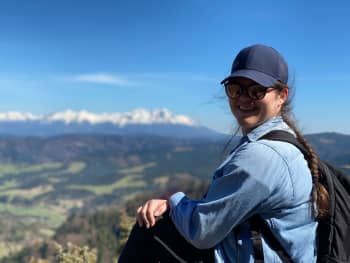
Photo: Courtesy of Zuzanna Babicka
Babicka says that training is key to forecasters making the most of new data tools presented by EUMETSAT’s next-generation programmes.
In June 2024, she visited EUMETSAT’s headquarters in Darmstadt, Germany, to attend a European Severe Storms Laboratory (ESSL) course on using Meteosat Third Generation satellite data in nowcasting.
“My visit to EUMETSAT was very inspiring and seeing the control room where the satellites are operated was incredible,” she says.
“As participants came from across Europe, it was also an opportunity to learn how different countries approach storm prediction and compare our methods for assessing storm risks.
“EUMETSAT’s latest satellite programmes – including imaging and sounding observations from Meteosat Third Generation – will play a key role in enhancing our forecasting abilities in the coming years.
“These new data streams provide near-real-time information on lightning flash rates, temperature, and humidity over Europe that forecasters simply didn’t have access to before.
“With these new near-real-time satellite datasets, you can see the parts of the forecast you get right, while fixing things that have not played out as anticipated, to improve the accuracy of the next part of the forecast.
“It’s also a tremendous learning opportunity. In my role, no two days are ever the same: If you’re interested in weather like I am, this job is like doing your hobby every single day.”
 Built with Shorthand